

Prompting Guide
To get the most out of LTX models, a strong prompt makes all the difference. The key is painting a complete picture of the story you’re telling — one that flows naturally from beginning to end and covers all the elements the model needs to bring your vision to life.
If you’re new to writing prompts for video generation, this guide will help you construct effective, production-ready prompts.
Table of Contents
- Key Elements to Include
- For Best Results
- What Works Well
- What to Avoid
- LipDub (Speech Replacement)
- Helpful Terms
- Sample Prompts
Key Elements to Include
When writing a prompt, aim to include the following elements:
1. Establish the Shot
Use cinematography terms that match your intended genre. Include shot scale or category-specific characteristics to refine the visual style.
2. Set the Scene
Describe lighting conditions, color palette, surface textures, and atmosphere to establish mood and tone.
3. Describe the Action
Write the core action as a natural sequence, flowing clearly from beginning to end.
4. Define the Character(s)
Include age, hairstyle, clothing, and distinguishing features. Express emotion through physical cues, not abstract labels.
5. Identify Camera Movement(s)
Specify how and when the camera moves. Describing how subjects appear after the movement helps the model complete the motion accurately.
6. Describe the Audio
Clearly describe ambient sound, music, speech, or singing.
- Place spoken dialogue in quotation marks
- Specify language and accent if needed
For Best Results
- Write your prompt as a single flowing paragraph
- Use present tense verbs for action and movement
- Match the level of detail to the shot scale
(close-ups need more detail than wide shots) - Describe camera movement relative to the subject
- Aim for 4–8 descriptive sentences
- Iterate freely — LTX is designed for fast experimentation
What Works Well
What to Avoid
LipDub (Speech Replacement)
The LipDub IC-LoRA is a video-to-video tool that replaces spoken dialogue in existing video. Unlike text-to-video generation, you are providing a source video and writing a prompt that describes what the speaker should say instead.
LipDub can be used for dubbing into other languages or for rephrasing dialogue in the original language.
Languages currently validated: English, French, Spanish, German, Russian.
Prompt Template
Example:
You can add details about emotion or delivery style to the prompt.
Requirements
- Provide the full dialogue text — the model will follow the content of the prompt. It does not translate dialogue for you.
- Use native script — write dialogue in the alphabet of the target language (e.g., Cyrillic for Russian, Chinese characters for Mandarin).
- Single speaker — the beta IC-LoRA does not distinguish between multiple speakers.
Best Practices
- Match audio length — For best results, try to keep your prompt at same timing and syllable length of the original dialogue. Slightly longer is better than too short.
- Prompt too long: The model might skip words.
- Prompt too short: The output might sound slow and unnatural.
Additional Helpful Terms
This list is not exhaustive, but provides useful examples for shaping your results.
Categories
Animation
- Stop-motion
- 2D / 3D animation
- Claymation
- Hand-drawn
Stylized
- Comic book
- Cyberpunk
- 8-bit pixel
- Surreal
- Minimalist
- Painterly
- Illustrated
Cinematic
- Period drama
- Film noir
- Fantasy
- Epic space opera
- Thriller
- Modern romance
- Experimental film
- Arthouse
- Documentary
Visual Details
Lighting
- Flickering candles
- Neon glow
- Natural sunlight
- Dramatic shadows
Textures
- Rough stone
- Smooth metal
- Worn fabric
- Glossy surfaces
Color Palette
- Vibrant
- Muted
- Monochromatic
- High contrast
Atmosphere
- Fog
- Rain
- Dust
- Smoke
- Particles
Sound and Voice
Ambient Settings
- Coffeeshop noise
- Wind and rain
- Forest ambience with birds
Dialogue Style
- Energetic announcer
- Resonant voice with gravitas
- Distorted radio-style
- Robotic monotone
- Childlike curiosity
Volume
- Whisper
- Mutter
- Shout
- Scream
Technical Style Markers
Camera Language
- Follows
- Tracks
- Pans across
- Circles around
- Tilts upward
- Pushes in / pulls back
- Overhead view
- Handheld movement
- Over-the-shoulder
- Wide establishing shot
- Static frame
Film Characteristics
- Film grain
- Lens flares
- Pixelated edges
- Jittery stop-motion
Scale Indicators
- Expansive
- Epic
- Intimate
- Claustrophobic
Pacing & Temporal Effects
- Slow motion
- Time-lapse
- Rapid cuts
- Lingering shot
- Continuous shot
- Freeze-frame
- Fade-in / fade-out
- Seamless transition
- Sudden stop
Visual Effects
- Particle systems
- Motion blur
- Depth of field
Sample Prompts
Example 1
Prompt:
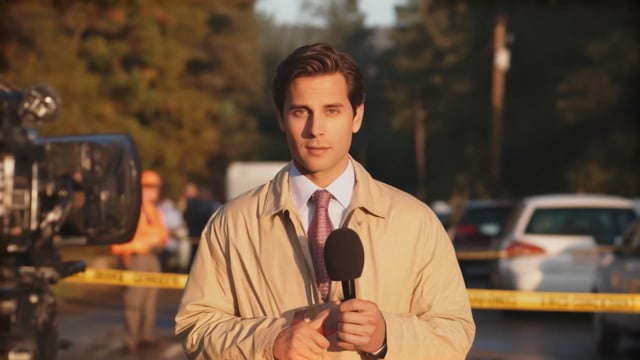
EXT. SMALL TOWN STREET – MORNING – LIVE NEWS BROADCAST The shot opens on a news reporter standing in front of a row of cordoned-off cars, yellow caution tape fluttering behind him. The light is warm, early sun reflecting off the camera lens. The faint hum of chatter and distant drilling fills the air. The reporter, composed but visibly excited, looks directly into the camera, microphone in hand. Reporter (live): “Thank you, Sylvia. And yes — this is a sentence I never thought I’d say on live television — but this morning, here in the quiet town of New Castle, Vermont… black gold has been found!” He gestures slightly toward the field behind him. Reporter (grinning): “If my cameraman can pan over, you’ll see what all the excitement’s about.” The camera pans right, slowly revealing a construction site surrounded by workers in hard hats. A beat of silence — then, with a sudden roar, a geyser of oil erupts from the ground, blasting upward in a violent plume. Workers cheer and scramble, the black stream glistening in the morning light. The camera shakes slightly, trying to stay focused through the chaos. Reporter (off-screen, shouting over the noise): “There it is, folks — the moment New Castle will never forget!” The camera catches the sunlight gleaming off the oil mist before pulling back, revealing the entire scene — the small-town skyline silhouetted against the wild fountain of oil.
Example 2
Prompt:
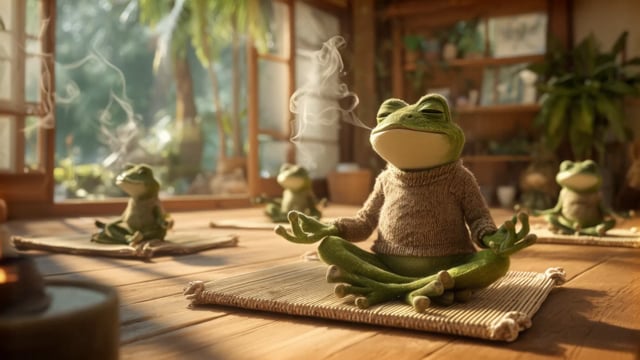
The camera opens in a calm, sunlit frog yoga studio. Warm morning light washes over the wooden floor as incense smoke drifts lazily in the air. The senior frog instructor sits cross-legged at the center, eyes closed, voice deep and calm. “We are one with the pond.” All the frogs answer softly: “Ommm…” “We are one with the mud.” “Ommm…” He smiles faintly. “We are one with the flies.” A pause. The camera pans to the side towards one frog who twitches, eyes darting. Suddenly its tongue snaps out, catching a fly mid-air and pulling it into its mouth. The master exhales slowly, still serene. “But we do not chase the flies…” Beat. “not during class.” The guilty frog lowers its head in shame, folding its hands back into a meditative pose. The other frogs resume their chant: “Ommm…” Camera holds for a moment on the embarrassed frog, eyes closed too tightly, pretending nothing happened.